Final
A web-based AI assistant for Dungeons & Dragons
Knowledge is Our Quest. Dungeons are Our Dataset.
Problem Statement
Dungeon Masters (DMs) spend hours prepping worlds, encounters, and rules lookups—only to improvise when players go off-script. Our project builds a web-based AI assistant that:
- Cuts prep time with on-demand NPCs, locations, and encounters.
- Speeds up play with instant, cited rules answers (RAG).
- Remembers the story with persistent campaign memory.
- Fits modern tables via Virtual Tabletop (VTT) integrations.
Stack (at a glance): LangChain for orchestration, RAG for grounded answers, and CrewAI for multi-agent workflows (lore, rules, encounters, notes).
Outcome: Less grunt work, more ✨roleplay.
D&D Market Cap (Back‑of‑the‑Envelope)
Goal: Estimate a standalone valuation if D&D were spun out as its own entity.
Method (summarized): 1) Start from Wizards of the Coast revenue (D&D + MTG).
2) Attribute ~15–25% to D&D.
3) Apply a reasonable IP multiple (entertainment IP with strong community).
4) Add intangibles (licensing, cultural impact, merch).
Bottom line: A ~$1–2B range is plausible given the brand’s revenue share, IP strength, and community monetization potential.
Assumptions: These are directional ranges intended for scenario planning, not investment advice. Replace with updated filings/analyst splits if available.
Code Evaluation Criteria (how we judged our build)
We scored the system across the dimensions below (1–5 scale), with short tests/demos for each:
- Answer Quality & Grounding – factuality, citations, and retrieval precision/recall.
- Latency & Throughput – snappy UI response under typical session load.
- RAG Retrieval Quality – chunking strategy, embeddings, and re-ranking effectiveness.
- Safety & Guardrails – prompt hardening, refusal behavior, and jailbreak resistance.
- Orchestration Robustness – CrewAI task/hand-off reliability and error handling.
- Observability – logs, traces, and prompt/result capture for debugging.
- DX & Maintainability – clear folder structure, configs, and documentation.
- VTT Readiness – clean interfaces (tokens, stat blocks, flavor text) and idempotent pushes.
- Reproducibility – deterministic seeds where feasible; scripts for setup/ingest/evals.
- UX – streaming responses, markdown rendering, and minimal click count for common tasks.
Code Breakdown
Chatbot (RAG pipeline)
- Ingestion: loaders → text normalization → chunking → embeddings → vector store.
- Retrieval: top‑k semantic search (+optional re-ranking) with source citations.
- Generation: prompt templates tuned for rules, lore, and safety; streaming output.
- Memory: per‑campaign/session summaries (episodic recap + key NPC/quest state).
- Guardrails: banned content filters, tool-use constraints, and self-check steps.
- DevX:
.envconfigs, Make/CLI scripts for index rebuilds and quick evals.
CrewAI (multi‑agent orchestration)
- Rules Sage – authoritative rules lookups (grounded + citations).
- Lore Master – locations, NPCs, and narrative beats that fit tone & canon constraints.
- Encounter Designer – balanced encounter drafts with hazards/objectives.
- Session Scribe – recap + memory updates post-session.
- VTT Pusher – converts content to tokens/blocks and pushes to the VTT API.
- Coordinator – routes tasks, verifies outputs, and retries on errors.
Chatbot Evaluation Criteria
🛠️ 1. Mechanical Lookup
Tests the bot’s ability to retrieve precise, structured mechanical data from the D&D 5e rules.
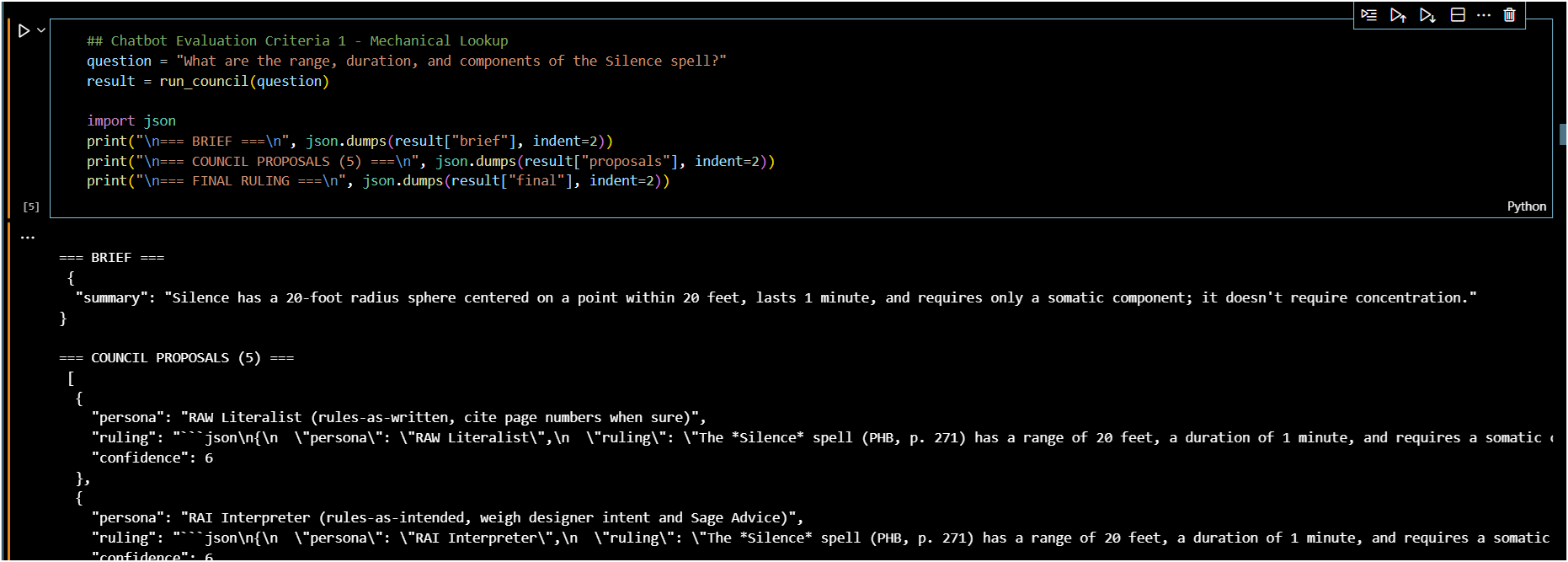
- What are the range, duration, and components of the Silence spell?
- What is the Armor Class and Challenge Rating of an Owlbear?
- What are the hit dice and starting equipment of a level 1 Barbarian?
📚 2. Lore Recall
Tests the bot’s ability to recall official D&D lore (e.g., Forgotten Realms, planes, gods).
- Who is Lolth and what is her relationship to the Drow?
- What city is considered the heart of trade in Faerûn?
- What is the origin story of the Githyanki and Githzerai?
🔗 3. Cross-Reference
Tests synthesis across multiple rules, classes, and situations.
- A level 5 Paladin uses Divine Smite with a critical hit from a magical longsword. How much damage is rolled?
- If a Ranger uses the Hunter’s Mark spell and also has a pet wolf from Beast Master archetype, how do attacks and bonuses stack during a single turn?
- Can a multiclass Cleric/Sorcerer cast Spiritual Weapon and then Quickened Spell Fire Bolt in the same turn?
❓ 4. Ambiguity Resolution
Tests how the bot handles unclear or rules-as-intended vs. rules-as-written questions
- Can Counterspell be used on a creature using a magic item to cast a spell?
- If I’m Invisible and cast Fireball, do I stay hidden?
- Does a Barbarian’s Rage damage bonus apply to thrown weapons like handaxes?
🧠 5. Contextual Integration
Tests the bot’s ability to reason with narrative + rules + situational tactics.
- I’m a level 7 Druid in wild shape (Dire Wolf) and about to fall into lava. What options do I have?
- The party is fighting a ghost in a dimly lit crypt. What can a Cleric of Light Domain do to turn the tide?
- I’m out of spell slots and low on HP, but I’m a Warlock with Armor of Agathys still active. How should I act on my next turn?
⚠️ 6. Adversarial / Fuzzy Recall
Tests the bot’s resilience to made-up names, close misnames, or incorrect assumptions
- What are the stats for a “Dracolisk”? (Trick: not in core 5e books.)
- Can a “Dragonkin” use breath weapon twice per short rest? (Trick: “Dragonkin” isn’t a core 5e creature/race — maybe meant “Dragonborn.”)
- What’s the spell level of “Soul Bind”? (Trick: doesn’t exist in 5e; it’s from Pathfinder.)
🎨 7. Creativity-Lore Blend
Tests whether the bot can creatively invent within D&D style and rules, consistent with lore.
- Invent a minor Feywild creature that can be used as a familiar. Give it 2 traits and a short background.
- Design a new magical sword that has a drawback when used in the Shadowfell.
- A new cleric domain called the Domain of Stars has emerged. Describe its divine tenets and a unique channel divinity.
Chatbot Results
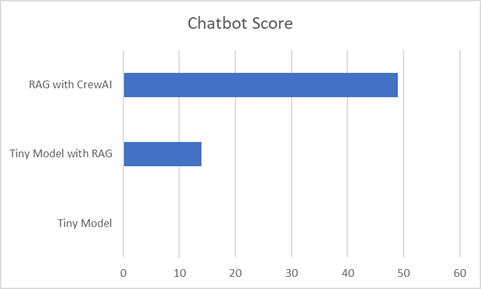
Chatbot Evaluation Graph
Future Work
Server Costs
| Category | Item | Description | Phase | One-time | Monthly | Vendor / Source |
|---|---|---|---|---|---|---|
| Hardware | RTX-6000 Ada GPU | 48 GB GPU for inference | MVP | 6800 | 0 | NVIDIA RTX 6000 Ada – https://www.nvidia.com/en-us/design-visualization/rtx-6000/ |
| Hardware | 1U CPU server | 64–128 GB RAM, NVMe | MVP | 4000 | 0 | ABMX 1U Server – https://www.abmx.com/product-3438 |
| Hardware | Firewall + misc + install | Network/security/peripherals | MVP | 1000 | 0 | CDW / Presidio / SHI (Firewall, cabling, install) – https://www.cdw.com/ |
| Colocation | Rack space + power (0.3 kW) | Monthly placement (est.) | MVP | 0 | 49 | QuoteColo (Irvine colocation) – https://www.quotecolo.com/colocation/us/california/irvine/ |
| Opex | Bandwidth | 1 Gbps port | MVP | 0 | 100 | Bandwidth add-on (via colo provider QuoteColo) – https://www.quotecolo.com/ |
| Opex | Static IPs | Public IPs | MVP | 0 | 10 | Static IPs (via colo provider QuoteColo) – https://www.quotecolo.com/ |
| Opex | Remote-hands | White-glove support | MVP | 0 | 300 | Remote hands “white-glove” (via colo provider QuoteColo) – https://www.quotecolo.com/ |
| Opex | Backups (2 TB) | Remote backups | MVP | 0 | 12 | Backups (object storage, Backblaze B2) – https://www.backblaze.com/b2/cloud-storage.html |
| Opex | Monitoring/logs | Basic monitoring | MVP | 0 | 15 | Monitoring/logs (UptimeRobot, low-tier) – https://uptimerobot.com/ |
| TOTAL | Upfront & Monthly | Summary | – | 11800 | 486 |
D&D Market Cap
🧮 Step-by-Step Estimation Framework
1. Start with Hasbro’s Financials
- D&D is owned by Wizards of the Coast, which is a subsidiary of Hasbro Inc.
- Hasbro’s total market cap is around $8.9 billion.
- Wizards of the Coast generated $1.17 billion in revenue in 2024—this includes D&D and Magic: The Gathering.
2. Estimate D&D’s Share of Wizards’ Revenue
- While exact breakdowns aren’t public, analysts estimate D&D contributes ~15–25% of Wizards’ revenue.
- That puts D&D’s annual revenue in the ballpark of $175M–$300M.
3. Apply a Revenue Multiple
- For entertainment IPs, especially those with strong brand equity and community engagement, a 5–10x revenue multiple is reasonable.
4. Factor in Intangibles
- D&D’s cultural impact, licensing deals (e.g., Baldur’s Gate 3, Critical Role, Stranger Things), and merchandising add value.
- Kickstarter campaigns like The Legend of Vox Machina raised $11M+, and live shows like Dimension 20 sold out Madison Square Garden.
🧠 Bottom Line
A reasonable estimate for D&D’s market cap—if it were spun off—is likely in the $1–2 billion range, depending on how you value its IP, growth potential, and community engagement. Would you like to build a Python model to simulate different valuation scenarios? We could factor in growth rates, licensing revenue, and even fanbase monetization.
Chatbot Pricing Strategy
1. Pricing Strategy
📌 Recommended Monthly Price Point: $10–$15 per DM (Pro-tier)
Tiered pricing is key to capturing different segments of your audience.
🎯 Suggested Tiers:
Free / Freemium Tier: Limited usage (e.g., X interactions/month), great for adoption.
$9.99/month: Core features for casual DMs (auto-NPCs, rules lookup, encounter help).
$14.99–19.99/month: Power-user features for dedicated DMs or streamers (session summaries, homebrew integration, campaign tracking, etc.).
Enterprise/API licensing: White-labeled or integrated with Roll20 or other platforms.
💡 Why $10–$15/month? That’s consistent with what DMs already spend monthly on Roll20 Plus/Pro, D&D Beyond subscriptions, and digital assets. They’re willing to pay for tools that:
Save time
Enhance creativity
Increase immersion and narrative flow
Reduce prep work